
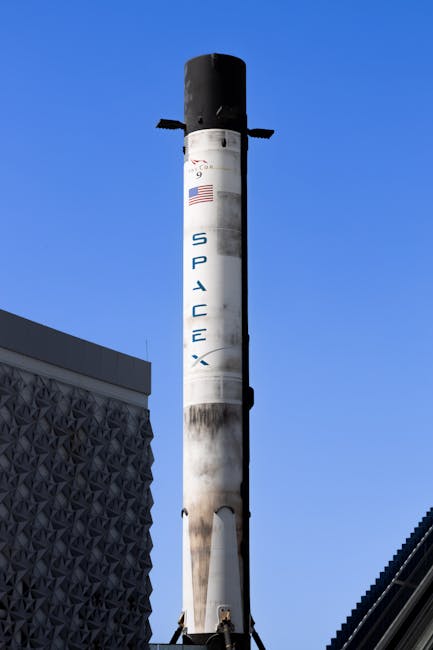
Elon Musk has announced his plan to build a mass driver on the moon, a giant cannon that uses magnetic power to accelerate objects into deep space. The lunar mass driver is a key component in launching the million satellites Musk wants to put in orbit around the Earth.
The idea of a mass driver is not new, as it was first thought of in the 1970s as a solution to the problem of launching spacecraft from Earth, which is extremely expensive. Every pound lifted from Cape Canaveral to low Earth orbit costs thousands of dollars in fuel, hardware, and operational complexity. A mass driver could break this stranglehold by using electricity instead of explosives, turning launches into a utility-scale operation. On the Moon, where gravity is one-sixth of Earth’s and there’s no atmosphere to create drag, this technology could launch payloads at a fraction of the cost – a few dollars per pound in electricity, compared to the $1,200 per pound it currently costs to launch a payload on a reusable Falcon 9 rocket.
A mass driver is basically a very long track stretching across the lunar surface, angled gently skyward at its far end. The track is lined with hundreds of electromagnetic coils, which are simply loops of wire that snap into powerful magnets the instant electricity runs through them. A payload sits inside a magnetizable carrier called a bucket, which is moved by the coils firing in a precise sequence, one after another. The result is a cascade of invisible magnetic hands, each passing the bucket to the next. The bucket never makes mechanical contact with any surface, which is why these systems have a theoretical operational lifespan of up to millions of launches with negligible wear. Musk describes it as a large maglev train, similar to the levitation technology that holds high-speed trains above their rails in Japan or China.
To achieve the required speed, the mass driver uses two distinct engineered stages. In the first, the coils sit at equal intervals and their electrical timing locks to the bucket’s exact position. In the second stage, the interval between coils progressively widens, which paces the pushes further apart in distance and holds the rate of acceleration constant. At the terminal end of the track, the bucket releases its payload – a xAI satellite according to Musk‘s vision – into space at a minimum speed of 5,300 mph, enough to escape the Moon’s gravity.
The system requires 8.7 to 20 megawatts of continuous power, enough to run a small town. Delivering that on the lunar surface requires between 400,000 and 634,000 square feet of solar arrays. However, the Moon endures two weeks of total darkness every month, which means the mass driver either sits idle for half of every lunar cycle or relies on supplemental power to keep firing through the night. NASA and the U.S. Department of Energy are developing a solution: The Fission Surface Power project, which builds on the earlier Kilopower research program to produce compact nuclear fission reactors.
Scaling from the $47 million 22-pound-launch prototype to a working lunar installation capable of launching huge satellites is where the vast distance between a compelling idea and a functioning machine becomes apparent. Musk‘s stated plan is to mine lunar silicon and oxygen and manufacture the server hardware on the surface – a bootstrapping strategy that, if it works, would reduce Earth-launch dependency over time. However, the superconducting coils at the heart of the mass driver require precisely manufactured materials that the lunar industry will not be able to produce in decades.
The technology is currently at readiness level 5 on NASA‘s 1-to-9 scale, with components validated in laboratories, not yet tested in space. Realistic deployment will take between 5 and 15 years from the moment serious investment begins, which can take the project into the 2040s. Musk‘s timeline is considered unrealistic, with his planned June 2026 initial public offering targeting a $1.5 trillion valuation being seen as overly ambitious. The gap between his renderings and actual functioning hardware remains a dream measured in decades, not years.














Leave a Reply